
Comdata Truck Stop Antitrust Class Action
Issue: Monopolization
On July 14, 2014, the Court approved a settlement of $130 million plus prospective relief in an antitrust class action lawsuit brought by truck stops and other retail fueling facilities that paid percentage-based transaction fees to Comdata on proprietary card transactions using Comdata’s over-the-road fleet card.
The complaint challenged allegedly anticompetitive arrangements among Comdata, its parent company Ceridian LLC, and three national truck stop chains: defendants TravelCenters of America LLC and its wholly owned subsidiaries, Pilot Travel Centers LLC and its predecessor Pilot Corporation, and Love’s Travel Stops & Country Stores, Inc. The alleged misconduct insulated Comdata from competition, enhanced its market power, and led to independent truck stops’ paying artificially inflated transaction fees.
In addition to the $130 million payment, the settlement requires Comdata to change certain of its allegedly anticompetitive business practices which will promote competition among payment cards used by over-the-road fleets and truckers and lead to lower merchant fees for the independent truck stops.
Visit truckstopantitrustsettlement.com for further details concerning the settlement and contact information for the claims administrator. The deadline for submitting a claim was June 4, 2014.
Civil Litigation News

Lieff Cabraser and Kaplan Gore Announce Filing of Federal Class Action Lawsuit Against Google Over the Defective Google Nest Hub, Google Nest Hub Max, Google Nest Mini, and Google Nest Audio Devices
Complaint alleges that Google induced plaintiffs and other customers to spend hundreds of dollars or more each to purchase Google Nest Hub,
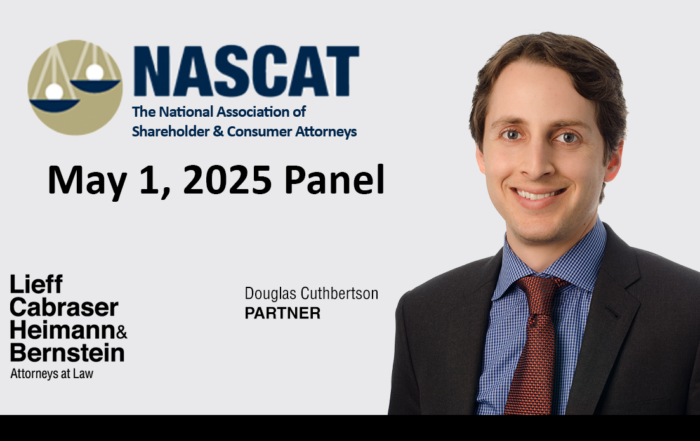
Douglas Cuthbertson to Discuss “Consumer Data Privacy” at Upcoming NASCAT Annual Meeting
Lieff Cabraser partner Douglas Cuthbertson will be a featured speaker at the 2025 NASCAT annual meeting. Doug will be speaking on the

San Francisco Schools Receive Financial Boost From Settlement With JUUL
As reported by the S.F. Chronicle, the San Francisco Unified School District has been awarded a substantial $24.65